 Skip-the-line available
 The Best Time to Visit Sanssouci Palace: A Seasonal Guide
When the fountains run, when the vineyard terraces bloom, and when Frederick the Great's yellow facade catches its finest light.
Sanssouci Palace, Frederick the Great's intimate Rococo summer residence above the six curved vineyard terraces of Potsdam, looks different in every season. The state foundation that runs Potsdam's royal palaces, which has stewarded the UNESCO-listed Palaces and Parks of Potsdam and Berlin since 1990, opens the palace year-round, but the experience changes dramatically between the fountain-on summer months and the quiet, winter-frosted park. This guide walks you through each season so you can choose the visit that matches your priorities, whether that is photography, fewer crowds, the Potsdam Music Festival, or the chance to stand quietly beside Frederick's tomb in the early-morning light.
Fountain season: late April through October
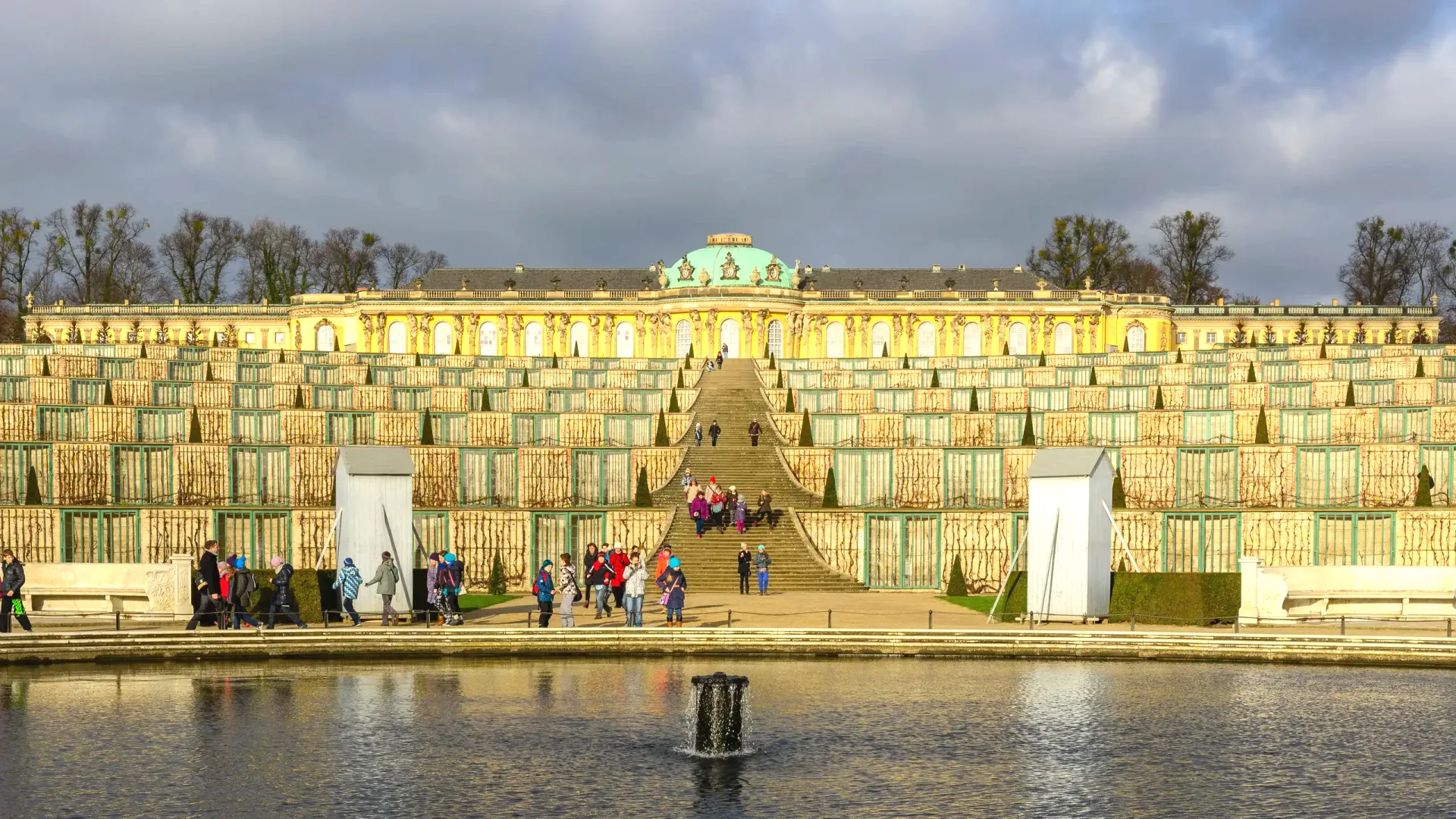
The Grosse Fontaene at the foot of the vineyard terraces and the Neptun-Grotte in the western park are switched on each year in late April and run until mid-October, a schedule the site authority has maintained for decades to protect the historic plumbing from frost damage. If you visit during this window, plan to be at the foot of the terraces between 11:00 and 16:00, when the main jets perform reliably. The fountain in front of the palace itself, framed by the famous six-terrace vineyard staircase, is the most photographed view of Sanssouci and the single image most visitors picture when they think of the palace. Outside this season the basins are drained and covered, the park is no less beautiful, but the postcard composition with the rising plume of water is genuinely only possible between late spring and early autumn.
May: the vineyard terraces in bloom
Frederick the Great's vineyard terraces are the architectural signature of Sanssouci. The six curved, south-facing terraces, each fronted with 168 glazed niches built to cultivate figs and grapes through the cool Brandenburg climate, were Frederick's personal obsession and the reason he chose this hillside for his summer residence in 1745. In early May the espaliered vines push their first leaves through the iron lattice of the glass fronts, and by mid-month the terraces wear a soft green veil that contrasts beautifully with the ochre-yellow palace above. the site authority gardeners still cultivate fig and grape varieties drawn from the eighteenth-century records, and informational panels along the central staircase explain the historic cultivars. May is also the month when the parterre below the terraces is at its richest, with tulip and early-summer plantings in the symmetric beds Frederick laid out personally.
Summer: the Potsdam Music Festival and long evenings
Each year in mid-June, the Musikfestspiele Potsdam Sanssouci, founded in 1991 and now one of the most respected early-music festivals in Europe, takes over Sanssouci Park for two weeks of concerts in the palace's small concert hall, the Neues Palais Schlosstheater, the Orangerieschloss, and the Friedenskirche. The festival is a genuine, structural reason to visit in June: it is the only time of year when Frederick's own concert hall is regularly used for chamber performances of the kind Frederick himself played on flute. Beyond the festival, summer days are long, with park opening hours extending into the early evening, and the late-afternoon light between 18:00 and 20:00 turns the yellow facade a deep amber. Weekends in July and August are the busiest of the year, so a weekday morning visit at 10:00 sharp is the simplest way to enjoy the interior in relative quiet.
Autumn: the best light of the year
Between mid-September and late October the angle of the sun drops, the air clears of summer haze, and the yellow Rococo facade of Sanssouci catches a glow that photographers travel from across Germany to capture. The Knobelsdorff facade, painted in the warm ochre Frederick personally specified, is south-facing and benefits most from low autumn light between 14:00 and 16:00. The vineyard leaves turn russet against the white glass niches, and the park's mature linden and oak avenues blaze gold. Visitor numbers drop sharply once the school holidays end in early September, making mid-week visits in October the single best balance of weather, light, and crowd density. The fountains continue running into mid-October, so the canonical postcard view is still available even as the trees colour. Autumn is also the quietest period for booking timed-entry slots, which means the small interior of Sanssouci can be enjoyed at a pace that simply is not possible in the high summer weeks.
Winter and December closures
Sanssouci Palace itself closes every Monday year-round and observes additional closures on 24 December and parts of 25 and 31 December for the Christmas and New Year period; the precise schedule is published annually on the site authority website and can shift by a day or two, so verify before travelling. Other palaces in the park, including the Neues Palais and the Orangerieschloss, follow their own winter schedules, with some buildings closed entirely between November and April. The park itself remains open year-round and is genuinely beautiful under snow, when the symmetric parterres and bare lindens reveal the underlying geometry Frederick designed. Winter visitors should also know that the fountains are off, the vineyard niches are shuttered, and tour-group volume is at its annual low, which means quiet interiors and the chance to linger in the Marble Hall and the Voltaire Room without queues.
Frequently asked
What month has the fewest crowds at Sanssouci?
November and February have the lowest visitor numbers, with mid-week mornings in either month often feeling almost private inside the palace. The trade-off is that the fountains are off and the vineyard terraces are dormant.
Are the fountains always running in summer?
The main fountains run reliably between 11:00 and 16:00 from late April to mid-October. Outside those hours individual fountains may be off for maintenance. the site authority publishes a weekly fountain schedule each spring.
What day is Sanssouci Palace closed?
The palace itself is closed every Monday year-round. Other buildings in the park have their own weekly closure days, with the Neues Palais typically closed Tuesdays.
Is Sanssouci open on Christmas Day?
Sanssouci is closed on 24 December and parts of 25 December and 31 December. The exact schedule is published annually by the site authority and varies slightly year to year.
When do the vineyard terraces look their best?
Mid-May for the spring leafing and richest parterre planting, and late September into early October for the russet autumn vine colour against the white glass niches.
Can I visit Frederick the Great's tomb in winter?
Yes. The tomb sits outdoors on the upper terrace beside the palace and is accessible whenever the park is open, which is year-round. Many visitors leave a single potato on the stone, a tradition recalling Frederick's role in popularising the crop in Prussia.
Is the Potsdam Music Festival included in a normal palace ticket?
No. Musikfestspiele Potsdam Sanssouci concerts are separately ticketed by the festival organisation. A palace day pass admits you to the buildings but not to festival performances.
What is the best time of day for photography of the palace?
Between 14:00 and 16:00 in autumn, when the low sun lights the south-facing facade directly. In summer, the late evening between 18:00 and 20:00 gives a softer, warmer image.
Does it ever snow at Sanssouci?
Yes. Brandenburg winters typically bring several snowfalls between December and February, and a fresh snow on the symmetric parterres is one of the most photographed winter views in Germany.