 Skip-the-line available
 Sanssouci vs Neues Palais: Two Palaces, Two Versions of Frederick the Great
One is intimate, one is colossal, and they were built by the same king twenty years apart to make two very different political points.
Sanssouci Park contains two palaces commissioned by Frederick the Great, and they could hardly be more different in scale, mood, or intent. Sanssouci, completed in 1747, is a single-storey Rococo retreat of ten rooms where the king played flute, dined with Voltaire, and asked to be buried beside his greyhounds. The Neues Palais, completed twenty-two years later in 1769 at the close of the Seven Years' War, is a 200-room state palace built explicitly to demonstrate that Prussia, despite the war's devastating cost, remained a great power. Together they are the two endpoints of Frederick's reign, and the comparison between them is the single most revealing thing a visitor to Potsdam can do.
Sanssouci: the intimate Koenigsschloss
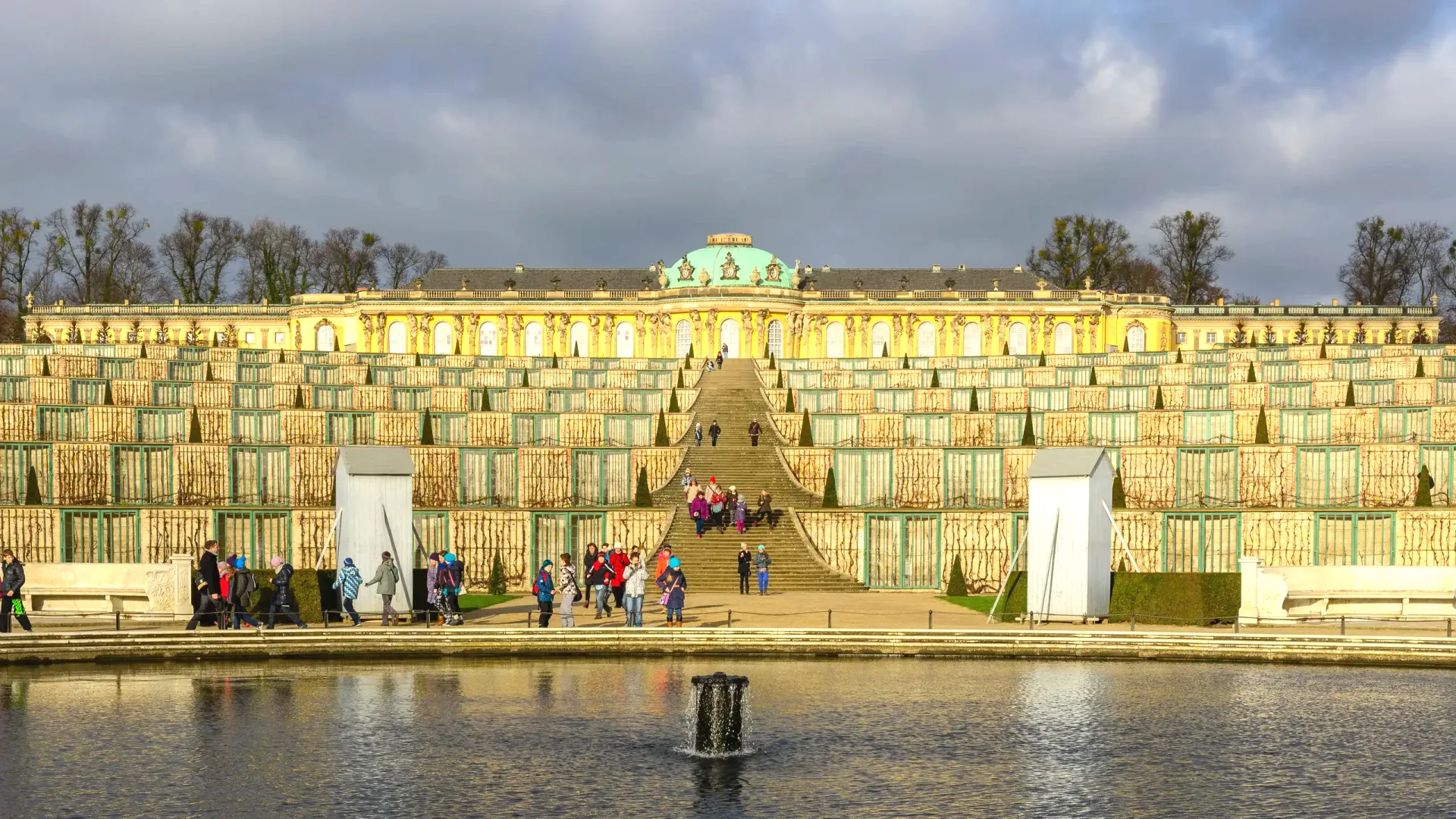
Sanssouci, completed in 1747 to designs by Georg Wenzeslaus von Knobelsdorff working from Frederick's own sketches, was conceived as the king's private summer residence and is famously a single storey with only ten main rooms. The name itself, French for 'without worry', captures Frederick's intent: a place to escape the demands of court life in Berlin and pursue his real interests in music, philosophy, and the slow cultivation of figs on his vineyard terraces. Every interior decision reflects this. The Marble Hall is oval rather than rectangular to dissolve hierarchy. The library is hexagonal and lined with cedarwood. The bedchamber, where Voltaire said he had slept in 'small but exquisite' rooms, has a single bed not a state bed. Frederick was buried, at his own request, on the upper terrace beside his greyhounds; his remains finally returned to Sanssouci in 1991 after a long post-war journey, and the tomb is now one of the most visited spots in the park.
Neues Palais: the post-war showpiece
The Neues Palais was begun in 1763, immediately after the Treaty of Hubertusburg ended the Seven Years' War, and finished in 1769 at a cost that nearly bankrupted the Prussian treasury. Frederick personally called the project his 'fanfaronnade', a deliberate bit of swagger, and the building is exactly that: more than 200 rooms across three storeys, a 213-metre facade, a grand cupola flanked by four sandstone Graces, and four court palaces, the Communs, built on the opposite side of the avenue purely to provide the visual mass the king felt the location demanded. Inside, the rooms scale up to a Grottensaal lined with shells, semi-precious stones, and minerals, and a Marmorgalerie of red and white marble that runs the full depth of the central block. Where Sanssouci is private, the Neues Palais is public, ceremonial, and built to be seen by foreign envoys. Frederick himself rarely lived here; it was reserved for state visits and for housing royal relatives.
Which palace to visit if you only have time for one
If you have only one palace's worth of time, the answer depends on what you want to understand about Frederick. Visit Sanssouci to meet the man as he wanted to be remembered: the philosopher-king, the flute player, the gardener of figs, the recluse who asked to be buried with his dogs. The interiors are smaller and easier to absorb, the queues are shorter because timed entry caps the numbers, and the surrounding vineyard terraces and ornamental garden are the canonical image of Potsdam. Visit the Neues Palais if you want to see eighteenth-century royal power at full scale: 200 rooms, a Grottensaal that looks like the inside of a cave of jewels, a theatre that Frederick used personally, and ceiling frescoes by Charles Amedee Philippe van Loo. The Neues Palais takes roughly twice as long to walk through and is the better choice for visitors with a strong interest in royal interiors and state architecture.
Doing both: the natural sequence
Most visitors with a full day in Potsdam see both palaces, and the natural sequence is Sanssouci first, Neues Palais second. There are practical reasons for this order. Sanssouci opens at 10:00 and timed-entry slots fill earliest in the day, so arriving for the first slot guarantees a quiet morning visit. From the terraces you walk west through the formal park along the Hauptallee, passing the Chinese House, the Sicilian Garden, and the Orangerieschloss along the way, a 25 to 35 minute stroll depending on how often you stop. The Neues Palais sits at the far western end of the park and has no timed entry inside its standard daily admission, so a midday or early-afternoon arrival is straightforward. Doing the sequence in reverse, Neues Palais first and Sanssouci second, is also possible but means a longer walk in the morning and the risk of missing the early Sanssouci slot.
What the two buildings tell us together
Frederick was 35 when Sanssouci was completed and 57 when the Neues Palais opened, and the gap between them captures the arc of his reign. Sanssouci is the work of a king at peace, newly secure after the First and Second Silesian Wars, who wanted a private retreat to think, write, and host the intellectuals of the French Enlightenment. The Neues Palais is the work of a king who had survived the Seven Years' War, who had watched Berlin be occupied by Russian troops in 1760, and who needed Europe to understand that Prussia had not been broken. Walking from one to the other in a single day, you are reading the political biography of an eighteenth-century state in two buildings. the site authority's day pass covers both, and there is no single experience in Potsdam more rewarding than spending the morning in Sanssouci's library and the afternoon in the Neues Palais's Grottensaal.
Frequently asked
How far apart are Sanssouci and Neues Palais?
Roughly 2 kilometres apart along the Hauptallee through Sanssouci Park, a 25 to 35 minute walk depending on pace and stops along the way.
Can I see both palaces in one day?
Yes. The the site authority day pass covers both and most visitors do them in a single day, starting at Sanssouci in the morning and walking west to the Neues Palais in the afternoon.
Which is more crowded?
Sanssouci is the more famous of the two and has strict timed entry, so its interior never feels crowded but tickets sell out earlier. The Neues Palais accepts larger numbers and has a more open flow but can feel busier inside.
Which has the better gardens?
The gardens are continuous. Sanssouci's immediate surroundings include the famous vineyard terraces, the ornamental parterre, and the rotunda; the Neues Palais sits in a more open park with formal lawns and the Communs across the avenue.
Where is Frederick the Great buried?
On the upper vineyard terrace beside Sanssouci, in a simple stone tomb beside his greyhounds. His remains were finally returned to this spot in 1991 after a long post-war journey through several locations.
Is the Neues Palais Frederick's home?
No. Frederick lived almost exclusively at Sanssouci. The Neues Palais was built as a state palace for receiving foreign envoys and housing royal relatives, and Frederick rarely stayed there himself.
What is the Grottensaal?
A grand reception hall in the Neues Palais lined entirely with shells, minerals, and semi-precious stones in the eighteenth-century grotto style. It is one of the most photographed interiors in Germany.
Which palace was built first?
Sanssouci was completed in 1747; the Neues Palais was completed in 1769. The two buildings are separated by twenty-two years and by the Seven Years' War.
Are both palaces open year-round?
Both close on different weekdays and both have reduced winter hours. Sanssouci closes Mondays, the Neues Palais closes Tuesdays. Verify the current schedule on the site authority website before travelling.